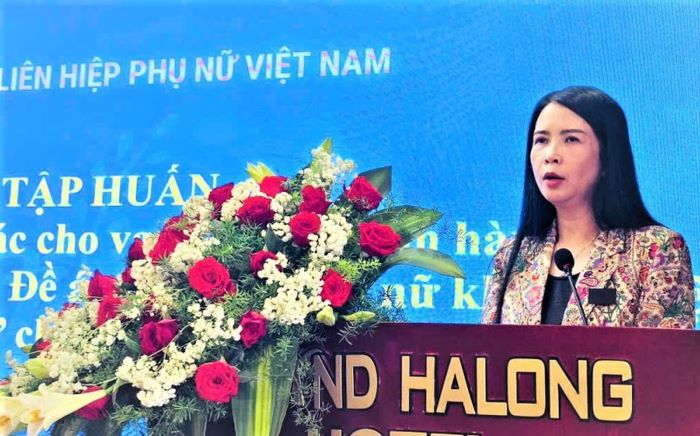
PRESENTATION BY Dr. AMELOU BENITEZ REYES, Philippines
INTRODUCTION
In the process, women have gained a deeper understanding of each other’s economies. We have gained APEC LEADERS’ recognition that investment in women is not just sound economics but is crucial in achieving the APEC’s goal of equitable and sustainable development.
My talk will discuss three areas: first, the gains achieved by the WLN together with the different APEC gender fora; second, the issues that need to be addressed; and third, some possible recommendations on future directions on how WLN’s capacity and networking can be further enhanced.
I wish to acknowledge the papers prepared by Andrina Lever of
In general, the WLN has been instrumental in organizing an APEC for a, which started as an Ad hoc Committee on Gender Integration into a Gender Focal Point Network, and the SME sub-committee on Micro-enterprises. Through the able and well-placed members, WLN had introduced significant policy statements in the declarations of Leaders and Ministers, particularly, for Small and Medium Enterprises (SMEs) and Trade and women ministers, regarding the further integration of women in APEC systems.At least two economies, one of whichwas
WLN’S MANDATE and ROLE
The primary mandate of the WLN is to integrate gender as a cross-cutting issue throughout APEC programs and policies.
The WLN is a flexible, consultative forum and a strategic partner of theAPEC Working Group of Small and Medium Scale Enterprises (SME) and the Gender Focal Point Network (GFPN) toward the achievement of the APEC vision, goals and action agenda. The 1996 Leaders’ Declaration in
The implementation of our economic cooperation agenda is based on genuine partnership in which all APEC economies contribute. We direct our ministers, working in partnership with the private sector, to identify ways to encourage such participation by all APEC economies. In addition, we ask that they put special emphasis on the full participation of women and the youth (para. 17 – APEC 1996).
As the APEC responded to current economic concerns, such as globalization, and threats, to economic prosperity, such as terrorism, pandemic diseases and natural disasters, in the region, the GFPN and WLN should likewise review its mandate on the full participation of women and the integration of gender in all APEC programs and policies.
Part I:Gains of Women’s Network
Annual Meetings and Themes
Since 1996,WLN organized annual meetings on the following themes:
·
·
·
·
·Brunei, 2000, SMEs as a Global Trader
·
·
·
·
·La Sirena, 2004 Women Entrepreneurs: Synergy Of Diversity” and sub-themes, Experiencing Our Diversity, A Commitment With Development Through Trade, Sharing The Benefits Through Best Practices, And Skills For The New Challenges
·Daegu, South Korea, 2005,Prosperity of Women Entrepreneurs through Innovation: New Visions for Women Entrepreneurs" and the sub-themes, Microcredit Policies and Programs for Women Enterprises Development, Co-prosperity through Promoting the Next Generation Women Entrepreneurs; Access to Innovative ICT Technology; Promoting Trade through Networking.
WLN Impact and Achievements ( based on Kartini ConsultingReport)
·The WLN played a substantial role in successfully advocating the adoption of a gender integration policy within APEC and the holding of three (3) Ministerial Meetings on Women and the creation of a SME Sub-group on Microenterprises.
·The WLN has been able to gain de facto recognition by APEC as an advisory body on gender in diverse APEC fora such as the SME Ministerial Meetings, the 1999 Trade Ministerial Meeting and the SME Sub-group on Microenterprises.
·The WLN has been able to contribute policy statements in APEC Leader Declarations and Ministerial Meeting Joint Statements every year since 1996.
·The Network has continued to organize annual conferences and policy drafting meetings with the support of host economies who act as secretariat.
Key Success Factors
The key factors identified by the same report that contributed to WLN’s success have been:
·The participation of some of Asia Pacific’s most influential women leaders from the business sector as well as highly respected academicians and a few key civil society women leaders;
·The coordination and synergy on advocacy initiatives related to key areas by the different sectors of the WLN;
·The multi-sector nature of the WLN (public, private, civil society and academic sectors);
·The mirroring of the APEC process in the WLN policy recommendation process and structure;
·The ability to steer a course which has always been just a bit ahead of what APEC Leaders and economies are willing to accept
·The support of influential leaders who have supported the WLN’s key recommendations.
PART 2:ISSUESCONFRONTINGWLN’SSURVIVAL AND SUSTAINABILITY
WLN’s survival is dependent on each host economy and its sustainability is dependent on the capability of its members.
In essence, the WLN is made up of two primary groups of women leaders. The first is a core group represented by the FOCAL POINTS, and the other ACTIVE WLN members who focus their energies on influencing APEC policy process. For the last decade, members of WLN have raised similar concerns regarding its future as an informal, public-private international network.
WLN’s evolution from a core group into a large group of experts and advocates has broadened awareness about issues of women in more APEC sectors and working committees and increased the demand for more concrete actions, programs and projects, not only for APEC, but also for the member economies. This poses a bigger challenge to WLN, to sustain its advocacy forgender integrationand at the same time, translate this into action in the various fora and economies.
Survival
Every year, the WLN meetings have been called through the generosity of host economies, with some uncertainties, particularly with regards the capability of host economies to mobilize a broad based international participation. The real concerns are for future host economies which seldom participate in annual APEC gender fora. Building their capability to mobilize participation in the annual GFPN and WLN meetings will have to be addressed.
·How can we assist under-represented economies when they become hosts to WLN meetings?
·How can we assist them participate in the GFPN?
Balanced representation
While the issue of organizational survival has always been raised every year, WLN has managed to broaden its memberships beyond the three sectors, business, government and non-government, to include academia in 1998 and indigenous women and rural women workers in 1999. Their concerns, therefore, have been integrated inthe policy discussions and recommendations.
Ms. Castillo raised the representation of these traditionally under-represented and under-privileged women who need to benefit more from the economic programs of APEC.
·How can WLN ensure the continued and active representation of underprivileged and under-represented women?
·What policy reforms will address their need to be mainstreamed in the economic processes?
WLN’s Role in APEC
“The asset in the WLN is its relationship to APEC which has an international and formal government structure…. as it gives it more status than other networks of women’s groups. However, because the WLN is not an official part of APEC, it has to continue to rely on APEC LEADERS to mainstream it into regular APEC activities”. ……(
The organization of the Gender Focal Point Network has institutionalized the implementation of the Framework Plan for Women through the designation of key persons in every APEC fora and APEC economy. Mainly staffed by national machineries for women and a few from the business and professional groups, the GFPN and its predecessors have benefited from new policy and program initiatives with broader regional perspectives from the WLN.
Sustaining Advocacy
Today, the lack of gender experts who can bring about more representation and involvement of women in the different APEC FORA and working committees is keenly felt.
·How can we galvanize more women to participate in the different FORA, to share their expertise and professional experiences in gender analysis and policy and program/project development?
WLN Annual Meetings. While the WLN recognizes the variety and extent of gender concerns and the necessity to make gender integration as a crosscutting theme in APEC, the WLN was essentially limited to annual meetings upon invitation by the host economy. The annual WLN Meetings have become a networking and a policy development event.
·Should the WLN continue to limit itself to annual meetings or should it consider organizing a wider range of activities?
A corollary issue is the responsiveness of the meeting format to address the multiple needs of its members.
·Do we follow workshop format? In workshops, there is a smaller number of participants.
·Do we followa Conference format where the host economy can showcase the contributions of women to its own economy or the best practices of women in the economy.
·Do we blend both? Combine both formats--one conference holding plenary and workshop groups to conduct gender analysis and draft policy recommendations.
Policy Development
The annual WLN Meetings continue to generate recommendations that are adopted by APEC Leaders and Ministers each year. However their content is sometimes very general in nature and does not address the specific APEC themes for the year. There is need to study the theme’s impact on women, not only by the host economy, but also by the participating economies so that true and responsive regional cooperation is achieved. The limited time frame to discuss, analyze and address these themes is another challenge.
·How can WLN members discuss, analyze, address the annual themes preparatory to the annual meetings?
Providing gender expertise to APEC
The WLN is a regional network of women ready and willing to contribute to APEC’s vision of equitable and sustainable growth. It consists of women leaders of diverse backgrounds from the 21 APEC economies who have made significant contributions in various fields.
This data base needs periodic review, screening and updating of its roster to be responsive to the annual challenges.
·Who will lead this task of seeking, contacting and orienting subject experts on APEC themes and processes?
Translating policy declarations into actions
The task of advocacy is no longer enough. Awareness has been raised and now is the time to put mechanisms that will translate these policies into concrete measures. one of those identified was the need to provide gender expertise and advise to economies, to APEC LEADERS and Ministers and to the different APEC fora and economies to follow through the implementation of policy declarations between the annual meetings. So far, the limited success can be traced to individual initiatives rather than institutionalized approaches.
·How should the WLN members follow through their policy recommendations with actions?
Effectiveness of WLN at the Economy Level
WLN Impact. In the past ten years, the WLN has grown in membership and in scope, and has made numerous recommendations.
·Has the WLN able to effectively integrated gender concerns in the various APEC FORA through their annual recommendations?
·Have the various recommendations considered by the APEC MINISTERS AND LEADERS adopted by the economies?
It is time for WLN to have real data on its impact: whether or not the message was getting through and whether or not its recommendations were being implemented.
WLN’sMonitoringRole
The biggest challenge facing the WLN today is how to monitor the implementation of gender-friendly policies and programs within APEC. Due to the voluntary nature of the network membership, and the responsibilities of its members, WLN is unable to follow through its recommendations and monitor their implementation.
·Who can monitor the effectiveness of WLN, if the Secretariat changes from year to year and economy themes vary from economy to economy?
·What monitoring process can the WLN set up to measure and further gender integration in APEC programs and policies?
WLN’S Records Management
The WLN does not have a formal repository of WLN records and files. Most of the pertinent documents are with the Canadian WLN Manager and we thank her/them for her invaluable service of records maintenance.
·Who takes care of circulating and managing WLN documents?
·To whom should the annual records of meetings be turned over?
·In summary, what will be WLN future role?
·Which of these functions can WLN members assume?
WLN Network Structure.
As an informal network of women leaders, WLN has no central decision-making body and no continuity of leadership. It is dependent on a small core of women who offer expertise and services on a voluntary basis from year to year. It has no legal personality to raise funds to support its activities, but depends solely on the Secretariat organized by the host economy for the purpose.
The proposed structure depends on the future functions which WLN will agree to assume. If the different functions for an effective organization will be adopted, a more permanent structure will be required. Last year, the WLN approved a permanent secretariat and in the preceding year, the
·How can we maximize the network structure and the secretariat?
·How can the network structure be made more effective and ensure continuity?
·Who and where should the WLN Secretariat be?
WLN in the APEC Structure
In a discussion first brought up in 1999, those who supported WLN’s informal status pointed out that this would allow flexibility and would fit APEC structure in whatever way is best suited to its purpose. Others have argued that, while formal status could bring constraints because of APEC’s commitment to consensus, it would be more difficult for any economy to ignore the wishes of a formally organized APEC body.
The annual WLN Meetings place a heavy workload on the host economy;the organizing committees do not receive much guidance regarding WLN meeting process, content and logistical issues.
Financial Challenges
The WLN has received substantial financial support from the Canadian International Development Agency (approx. US$535,000 as of 2000). Modest amounts for specific projects have come from UNESCO and UNIFEM, and the host economies have also extended logistic support to the conduct of the WLN meetings.
Andrina Lever, Focal Point for
While CIDA shall continue to support the work of the WLN, it is not realistic to expect it to be the single largest and most consistent funding source of the WLN. As such, alternative funding sources and methods need to be explored and established in order to ensure its sustainability.
In addition and to date, the WLN has been invited into the host economy for APEC as a courtesy by that economy. As the WLN has grown larger and more ambitious the costs and expectations to the host economy has grown as well. While it is desirable and hopeful that each economy shall host WLN during its year as APEC host, it is not required and not certain that each economy shall do so.
The Canadian WLN Manager recommends funding of six essential services estimated to require 8 months (Paper prepared for WLN March 2001 by Dana Peebles). Clearly, there is a need to ensure that the WLN can cover the essential services. Dana Peebles has identified potential sources of funding, namely: corporate sponsors, the Japanese International Cooperation Agency (JICA), and WLN members.
·Should the WLN continue to operate on a voluntary basis? or,
·Should it seek funds to pay for these services?
·How will the network finance its future activities and sustain its organizational
successes, growth and development for the next decade.
PART3: RECOMMENDATIONS
The ideas and concerns which I discuss are not new. The issues posed here have been discussed in several WLN fora and several position papers have been presented.Based on the results of the evaluation of WLN from 1996 to 2003, I have added more.
APEC has a gender integration policy in place, however, there is still a need for WLN to considerthe following to implement this effectively, through---
a)Developing ways to provide APEC fora with the support it needs to integrate gender effectively in all its policies, programs and projects through the appropriate APEC fora and working committees and
b)Maintaining pressure on economies to support the active participation of women in the different APEC fora.
Deciding on the future role of WLN
APEC needs strategic policies that go beyond the planning of the annual WLN meetings into translating these into concrete activities, projects or programs. For this, the following functions have to be formalized:
i.Strategic policy studies
ii.Translating policy into action through
1.Advocacy
2.Communication
3.Providing gender expertise and advise
iii.Monitoring and evaluating the effectiveness of policy declarations
iv.Records management
In order to increase its influence within the APEC processes and to help coordinate the advocacy processes at APEC, a repository of information and a communication program should be set up.
Formalizing WLN as an APEC body
The core group can continue work on the restructuring of the WLN as an effective advisory body of APEC at the level of Senior Ministers and Leaders and at the same time, it can be an appendix to the GFPN, lending expertise, organizing women leaders for advocacy and networking and facilitating consensus-building.
A recognized APEC body will have more influence and will have access to funds that will ensure the sustainability of the WLN as an organization, and support its advocacy and programs and activities.
Establishing continuity in the WLN Secretariat
Thetime has come for the WLN to move forward to consolidate and build on its strengths. With the agreement on a permanent Secretariat, a Secretary who will always be part of the APEC Secretariat should be designated to provide continuity as the meeting moves from one economy to the other.
Functions. The WLN Secretariat will be responsible for the following functions as adopted from the recommendations of Kartini Consulting.:
·Documenting andconsolidating the network’s achievements
·Providing technical advise on how to organize an annual WLN meeting
·Developing the local economy WLN chapters
·Facilitating the building of consensus within the WLN regarding policy positionsand the WLN itself
In addition, the WLN Secretariat will be tasked with:
·Facilitating strategic and annual planning
·Expanding WLN membership and linkages
·Increasing participation in working groups
·Coordinating all WLN programs and activities
·Monitoring the implementation of the APEC policy to mainstream gender issues
·Reviewing the impact of the WLN’s recommendations
·Establishing a central repository of WLN records and files
·Disseminating information to focal persons
·Maintaining WLN Female Expert Database
·Developing an annotated bibliography of WLN papers since 1997
·Updating and maintaining the WLN website
This assumes that, in between the annual meetings, WLN members commit to ----
·Assisting their respective economies adopt APEC policies and develop projects to ensure that gender-related initiatives are carried out
·Conducting strategic studies on key issues
·Documenting and reporting best practices
·Drafting position and discussion papers for various WLN fora
·Organizing and sustaining WLN organizations in their respective economies
CONCLUDING REMARKS
It’s time for decisions and corresponding actions. There is still a lot to be done in terms of increasing women’s participation inAPEC bodies and fora and with our collective efforts, we can do it..
In closing, allow me to extend my congratulations to the WLN members for sharing our advocacy in promoting the welfare of women. I thank each one of you, particularly the WLN –