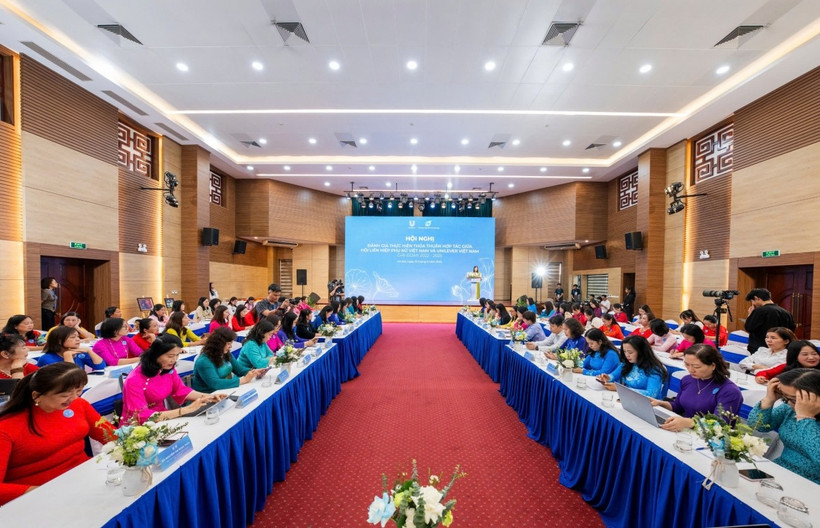
CHOBA Project - Workshop on sharing and exchanging experiences and orientation activities in 2013

The workshop aims to report the results of project implementation, discussing and sharing experiences of the implementation the project at the provincial level and providing orientation for 2013. The workshop was attended by a large number of representatives from relevant ministries and departments, representatives of the People's Committee, the medical center, Social Policy Bank, and the Women's
Opening the seminar, Vice President of the VWU and Project Director, Ms. Tran Thanh Binh said: The VWU is honored to be partner of the EMW to perform community hygiene activities based on the outputs in the period 2012-2015 in Dong Thap, Tra Vinh , Tien Giang, Quang Binh, Thanh Hoa, Ha Tinh , Hai Duong and Ninh Binh provinces. These are the eight pilot provinces of the project, which can then be replicated across other provinces, and contribute to the implementation of the National Target Program: Rural clean water and environmental sanitation of the Government.
Ms. Thanh Binh appreciated the economic and social meaning of the Project, though especially the deep humanity of the Project as it is directed towards providing benefits to low income and poor persons, through improving sanitation conditions, health, and the quality of life. Utilizing a results-based approach, the Project seeks to greatly contribute to the creation of hygiene needs and changing the behavior of the community. Simultaneously, the project also contributed to the VWU campaign, "Building a family of 5 withouts and 3 cleans". As a Project Director, the Vice President emphasized that the project has achieved many significant results, as in just 6 months, more than 500 staff members received training and the construction of more than 2,000 hygienic latrines was completed. However, the Project has also faced many difficulties utilizing new approaches and technical requirements that the VWU has limited experience with. In addition, the Project also requires coordination, consistency, and coherence from all ministries and agencies, from the central to local level, in education, and the organization and implementation of Project activities. Therefore, in the workshop, Ms Thanh Binh highlighted four issue areas for participants to concentrate on, study, and discuss. She called on participants to provide insightful opinions, propose solutions to implementation challenges, identify problems in coordinating for the PMU support, provide methods to mobilize local resources, and how to integrate project activities with other programs.
The CHOBA Project started in July 2012, and after six months of implementation the project has achieved many positive results. According to reports, as soon as the project was signed, the VWU (chair organization of the project) focused on the timely direction of the project. The VWU has both issued guidance and implemented many Project activities from the central to the provincial level, such as creating and strengthening the organizational structure of the project, demonstrated during the “Project implementation Minutes” signing ceremony and the Project implementation seminar. In collaboration with the Department of Environmental Management-Ministry of Health, Project activities also include organizing 8 training courses on environmental hygiene for the provinces implementing the Project, establishing the PMU, constructing operation regulations, and completing the master plan for 3 years. In just six months, 215/245 communes established a PMU at the commune level, 119/245 communes held a training course, 100% of the provinces conducted at least one active starting sample in the community, 50% of the provinces held training courses, and most notably, more than 500 staff members were trained and 2008 latrines were built. These results have been noted and appreciated by EMW Deputy Director Ms. Vo Thi Hien. She also praised the close collaboration between Women's Union staff and EMW, the positive direction, the creative dynamic in mobilizing other resources, and the Project’s implementation in Tra Vinh, Thanh Hoa, Ha Tinh, Ninh Binh, Hai Duong provinces.
At the workshop, participants heard presentations on the following topics: the work of advising the provincial People’s committee on coordinating this Project with the implementation of the National Target Programme “Rural clean water and environmental sanitation”; the role of commune level WUs in selecting beneficiaries, as well as inspection, monitoring and reporting; and mobilizing community resources for the Project and integrating the National Target Programme into the implementation of the CHOBA Project. Problems and solutions of local project implementation, coordination methods, and the mobilization of resources were also discussed in order to share experiences in implementing the project, problem solving, planning activities, in an effort to achieve better results in the future, and contribute to the successful implementation of the National Target Programme and the construction of new rural areas across the country.
In 2013, the project will be implemented and continuously expanded, with the PMU being established and maintained. Regular meetings will be held by the PMU, an initial survey on status of latrines will be completed, training courses will be organized, activities and meetings on the overall hygiene practices of the community will be held; activities household group, raising capital will be organized...
The project "Community Hygiene Output-Based Aid " (CHOBA), carried out by Vietnam Women's Union in collaboration with the East Meets West Organization and the Department of Environmental Management - Ministry of Health, started in July 2012 and will be implemented until June 2015, in 8 provinces.The project aims to: improve sanitation conditions for 1.4 million people in the rural areas of the country, support around 125,000 member households, especially disadvantaged women, to build and use latrines, and learnhygiene practices (hand washing with soap, etc.), disseminate sanitation information to 125,750 people, increase the use of latrines to greater than 30% in 244 project communes, and mobilize rural communities to engage in hygiene practices such as hand washing with soap, the safe handling of drinking water and garbage treatment.Activities of the project will be carried out through the application of a combination of different approaches in hygiene, such as: raising awareness of environmental hygiene to create demand among the people, mobilizing and establishinglocal support networks (including networks of communicators and builders), and supporting people to access financial resources.In order to stimulate demand for the construction of sanitary latrines and to increase the percentage of those with access to sanitation and applying hygiene practices in the community, the CHOBA project will utilize a results based approach, with financial incentives including: bonuses to the communicators at the commune level and households and commune units based on the results achieved.