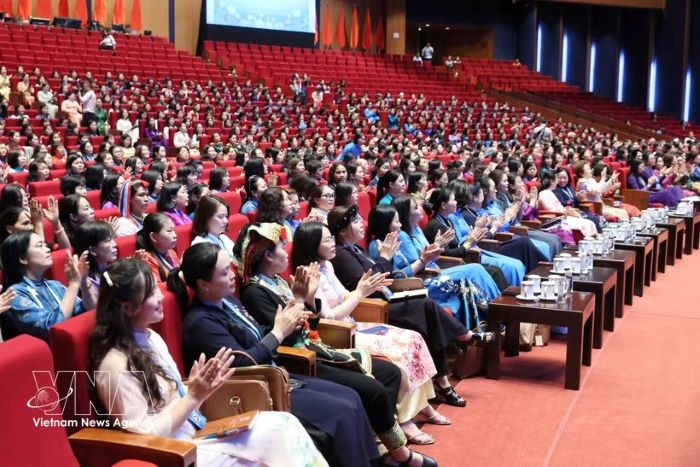
Female intellectuals contribute to theoretical and development research
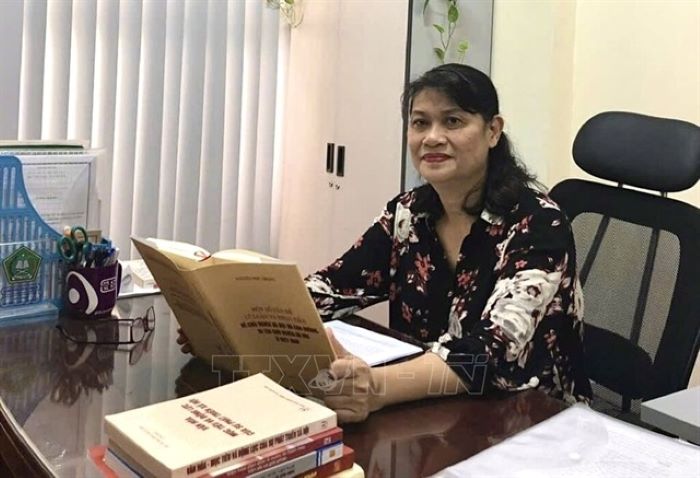 Associate Prof. Dr Nguyễn Thị Lan Hương, a reseacher at the Institute of Philosophy.
 In the field of social science research, many female intellectuals are contributing valuable works, providing scientific data for the development of theory and policy making.
From political theory research to sustainable development issues, these contributions not only enrich academic knowledge but also help solve practical problems arising in the process of national development.
Consistency with research in the digital age
Associate Prof. Dr Nguyễn Thị Lan Hương, from the Institute of Philosophy (Việt Nam Academy of Social Sciences), is a long-standing researcher in the field of political theory.
Recently, her work 'Building the Party Politically in the Digital Age - Some Issues to Note' was honoured at the 10th National Press Award on Party Building (Golden Hammer and Sickle Award) in 2025 in the category of Outstanding Work Developing Theoretical Aspects of Party Building.
Hương said that the intention of pursuing philosophy study was not her first choice.
In 1985, she passed the entrance exam to Hà Nội University with the desire to study chemistry or biology.
However, according to the university's arrangement, she was assigned to the Philosophy Department, a field that was still quite new at the time.
After a few months of studying, she gradually realised that this field of study turned out to be more appealing than she had imagined.
“Philosophy not only requires a broad knowledge base but also demands the ability to think systematically and analyse social issues in depth,” Hương said.
“Experienced lecturers at the Hà Nội University during that period inspired a passion for scientific research in many generations of students.”
After graduating in 1990, due to the practicalities of her field of study and personal circumstances, she worked in the local education sector as a foreign language teacher.
However, the desire to return to philosophical research always motivated her to continue pursuing this field.
In 1998, she passed the recruitment examination for researchers at the Institute of Philosophy and became a full-time researcher.
Working in the specialised research environment, she continued to complete her doctoral dissertation in philosophy in 2008.
Since 2015, she has worked at Philosophy Magazine. Working here has helped her approach new issues and contribute to spreading theoretical research to the scientific community and society.
Her work that won the Golden Hammer and Sickle Award focused on analysing challenges of Party consolidation in the context of the strong development of the 4.0 Industrial Revolution and the digital age.
According to the professor, the digital age opens up many opportunities for development but also brings new challenges for ideological work and Party building.
In cyberspace, numerous streams of information, both positive and negative, spread rapidly, creating a complex information environment. Hostile forces also exploit this environment to distort the Party's ideological foundation.
Given this reality, she believes that political and ideological education needs to be reformed to be more dynamic, relevant to practice, and to utilise digital technology platforms.
The goal should not only be to impart knowledge but also to equip cadres and Party members with critical thinking skills, the ability to analyse and identify information in a multi-faceted media environment.
“For female intellectuals, the path of scientific research always requires a lot of effort, because in addition to their professional work, women also have to take on many responsibilities in the family,” Hương said.
“Therefore, organising time effectively and balancing work with family life is an important factor that helps women pursue a long-term research career.”
Human geography research and sustainable development practices
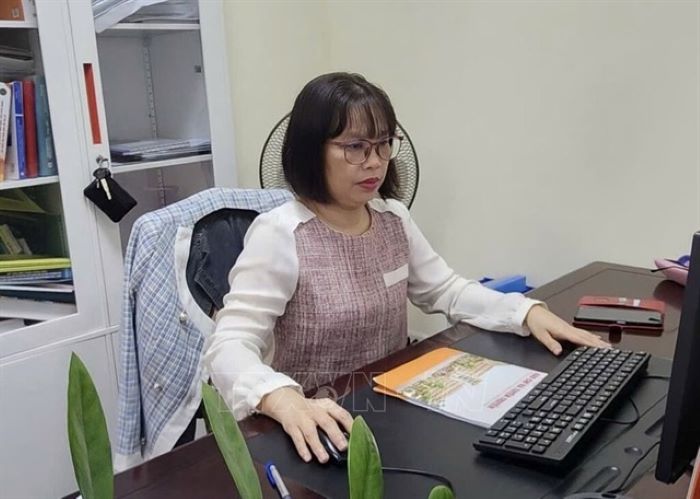
Dr Trần Thị Tuyết at work.
While theoretical research contributes to clarifying ideological issues and development orientations, research in the field of human geography provides scientific arguments that directly serve the planning of socio-economic development policies.
Dr Trần Thị Tuyết, senior researcher at the Institute of Human Geography and Sustainable Development (Việt Nam Academy of Social Sciences), is one of the female scientists who persistently pursues this research direction.
After graduating from the Geography Department of the University of Natural Sciences in 2000, Tuyết continued her studies and earned master's and PhD degrees in geographic science.
Since the first research on economic development connecting with environmental protection in Móng Cái city, Tuyết has focused her research on the fields of territorial planning, regional linkages, and sustainable resource management.
During her career, she participated in 28 scientific research projects at various levels, including 13 as project leader.
Her research spanned a wide range of topics such as sustainable urban development, regional linkages in climate change response, adaptive livelihoods of coastal communities and human resource development for green growth.
A highlight of her work is her interdisciplinary approach, combining physical geography, human geography and public policy.
This approach allows her research to go beyond academic analysis and provide scientific arguments for the development and adjustment of policies in many localities.
Notably, one of her State-level research projects is the one on building a policy framework for proactively adapting to climate change in the Mekong Delta using a socio-ecological approach.
The research proposed a system of solutions and development models consistent with the 'harmonious with nature' perspective, contributing to providing a scientific basis for the implementation of Government Resolution 120 on sustainable development of the Mekong Delta region, adapting to climate change.
By 2025, she had published 82 scientific works domestically and internationally, contributed to 13 books and numerous international book chapters.
In parallel with her research work, she teaches the environmental policy course at the Academy of Social Sciences and supervises many students and doctoral candidates.
Her supervised projects are all linked to local realities, demonstrating a strong connection between academic research and the specific development needs of each region.
Sharing her research journey, Tuyết said: “Social science research, especially in the field of human geography, needs to be closely linked to practical development.
“Research is only truly meaningful when it can provide scientific arguments for policy planning and adjustment.
“The important thing for scientists is to persistently pursue research problems while always connecting with practice so that scientific results can make a practical contribution to the sustainable development of the country.”